
Hej
Civil Defense 2.0

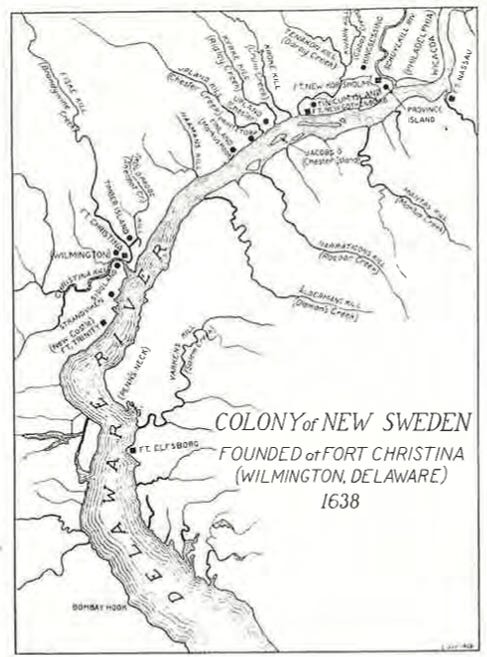
Nya Sverige / New Sweden
The year is 1655. The Dutch have taken New Castle and have their eyes on Wilmington. They’re raiding Finnish homesteads all over New Castle County and have Fort Christina surrounded. By this point, according to Amandus Johnson in The Dutch and Swedes on the Delaware, “The fort had been reduced to its last extremity, the guns of the Dutch were pointed at the walls, and everything was ready for an attack. The [Swedish] officers saw the futility of further resistance… Rising [Governor of New Sweden] warned his opponent not to press his demands too far, as the consequences might have far-reaching results in Europe, but Stuyvesant [Director-General of New Netherland] would listen to no other terms than ‘complete and unconditional’ surrender. Finally Rising agreed to give up the fort.” New Sweden was no more.
It could be the 400+ day Swedish Duolingo streak, my Swedish heritage (Shout out to my great grandfather, Gustaf Lindstrom), or the fact that the Kelly family just set sail on the Kalmar Nyckel right next to where Fort Christina once stood, but, sheesh, what a ride... Though, even before being ousted by Stuyvesant and the dastardly Dutch, the Swedish colony had a pretty tumultuous history. Throughout Delaware’s stint as New Sweden, from 1638-1655, the early pre-Delawareans were plagued by a lack of investment, a lack of supplies, and the fact that virtually no one actually wanted to leave Sweden in the first place. What started as a flashy, high-profile project supported by Gustavus Adolphus himself (Have you seen how much the Dutch East India Company is making?!) ended quietly, with little fanfare.
So what have the Swedes been up to for the past 371 years? Of course, there’s the furniture, the boxy cars, the fish, Snake, and the ability to connect to your AirPods. More recently, though, there’s the complex geopolitics, the militarization of the region, and the conflict that pushed the traditionally neutral Scandinavian nation into NATO membership. Post Adolphus Sweden has been spurred to action. So much so that in 2024, the Swedish Civil Defense and Resilience Agency, formerly MSB, and the Swedish government went as far as to publicly refresh their civil defense outreach program and revive mandatory service for those between 16 and 70 years old. What else, though? From an emergency management perspective, where do these efforts fit into their overall crisis management structure and how drastic are these changes actually?

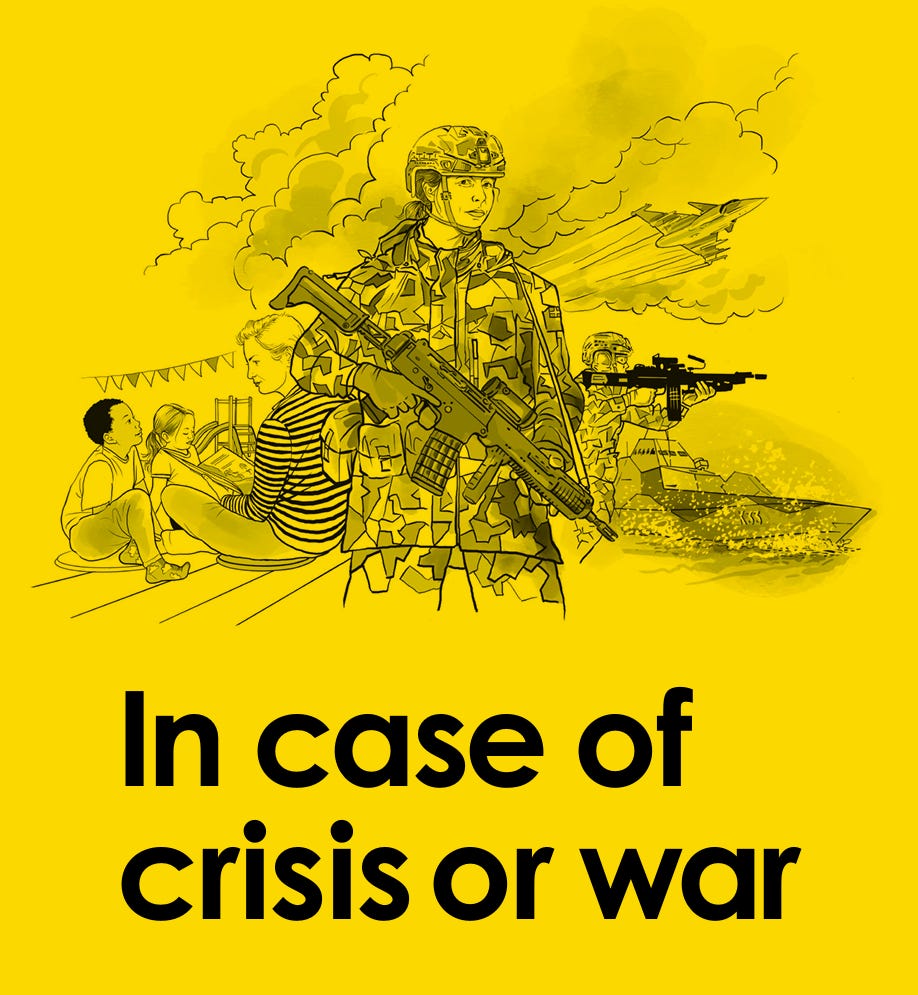
“We live in uncertain times. Armed conflicts are currently being waged in our corner of the world. Terrorism, cyber attacks, and disinformation campaigns are being used to undermine and influence us. To resist these threats, we must stand united. If Sweden is attacked, everyone must do their part to defend Sweden’s independence – and our democracy.”
— The Swedish Civil Contingencies Agency (MSB)
Civilt försvar i Sverige / Civil Defense in Sweden
In Sweden, emergency management is the responsibility of the Swedish Civil Defense and Resilience Agency. With Director General Mikael Frisell at the helm, the agency currently has around 1,400 employees, with operations in Stockholm, Karlstad, Kristinehamn, Sandö, Revinge, and Rosersberg.
Pretty impressive for a country of 10.7 million people. Roughly comparable to the population of Michigan or North Carolina. By comparison, not counting reservists and contract employees, FEMA has about 5,000 full-time employees for 340-ish million people... More similar to the United States, where emergency management is shaped by laws such as the Stafford Act, PKEMRA, the Sandy Recovery Improvement Act, and the Disaster Recovery Reform Act of 2018, Sweden’s emergency management structure is also guided by legislation. Some of the standouts for the Scandinavians include the 2003 Act on Protection Against Accidents, the 2022 Ordinance on the Preparedness of Government Agencies, and the Act on Municipalities’ and Regions’ Measures Prior to and During Extraordinary Events in Peacetime and Heightened State of Alert in 2006 (😵💫).
Act on Protection against Accidents (2003) - Dictates individual, municipal, and state roles and responsibilities, especially as they relate to planning, prevention, public warning, and mitigation work.
Ordinance on the Preparedness of Government Agencies (2022) - Strengthens government agencies’ ability to increase capacity during peacetime and during times of heightened alert by mandating training, planning, information sharing, and exercise activities nationwide.
Act On Measures Taken By Municipalities And Regions Before And During Extraordinary Events In Peacetime And Heightened Preparedness (2006) - Besides being quite the mouthful, this act helps strengthen preparedness efforts throughout Sweden by, among other things, mandating local government risk assessments and local crisis management boards.

Beyond legislation, you can’t discuss emergency management policy in this part of the world without considering the geopolitics of northern Europe. As of March 7, 2024, Sweden officially became a member of the North Atlantic Treaty Organization (NATO). While Sweden has had a Total Defense policy in place since the early 90’s, with NATO membership comes the need to further support those treaty obligations.
“Civil preparedness is a central pillar of Allies’ resilience and therefore a critical enabler for the Alliance’s collective defence … Fundamentally, it is about ensuring the continuity of critical societal functions, including access to food and water, health care, transport, energy and communication. The government has tasked the Swedish Civil Defence and Resilience Agency with coordinating Sweden’s participation in NATO’s civil preparedness efforts. The agency also represents Sweden in the Civil Protection Group (CPG) under the Resilience Committee.” - Swedish Civil Defense and Resilience Agency
While the Swedish civil defense and emergency management apparatus appears to have been focused and productive since they were ousted from the New World in 1655, their system, from an All-Hazards perspective, according to some, has left some room for improvement. However, any critiques of their approach to crisis management have to be considered within Sweden’s own context. A country of 10 million, with a more limited natural hazard profile than the United States, it makes sense that its system would be designed around what it considers its greatest threat. Right? Though with civil defense primarily being thought of in the US as a legacy Cold War concept, one can ask, if it’s having a moment elsewhere, should it make a comeback here as well? Back across the Atlantic to New Sweden to discuss.

Tillbaka till framtiden? / Back to the future?
Following Sweden, Germany, and others’ lead, should we jump in the DeLorean, hit 88mph, and go back to the future on the civil defense bandwagon here in the United States as well? As there’s been more instability and uncertainty within our federal emergency management apparatus, this is something that has come up as an alternative approach to the status quo. So, is civil defense the next phase of emergency management in the US? Not necessarily.

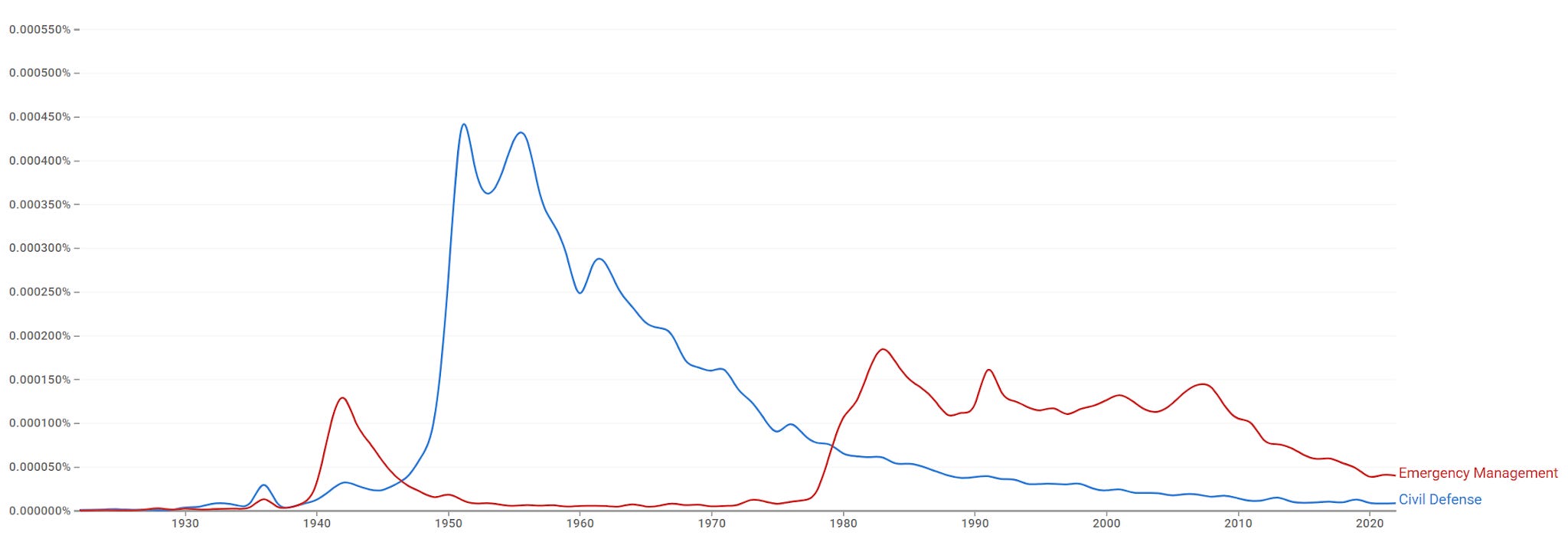
Pumping the brakes on the DeLorean and looking back, the history of civil defense in the US isn’t as rosy as you might think. According to Lee Clarke in Mission Improbable, “The halcyon days for civil defenders were 1962 and 1963. In 1962, Congress at first gave the Kennedy Administration about $87 million of its requested $105 million, then supplemented that amount in the same year with a whopping $207 million; in 1963, the corresponding figures were $113 million (though Kennedy requested $695 million) and $15 million. But most years civil defense appropriations ranged from about $50 million to $70 million, with Congress regularly reducing the amount requested by 40 percent or more.” Not great.
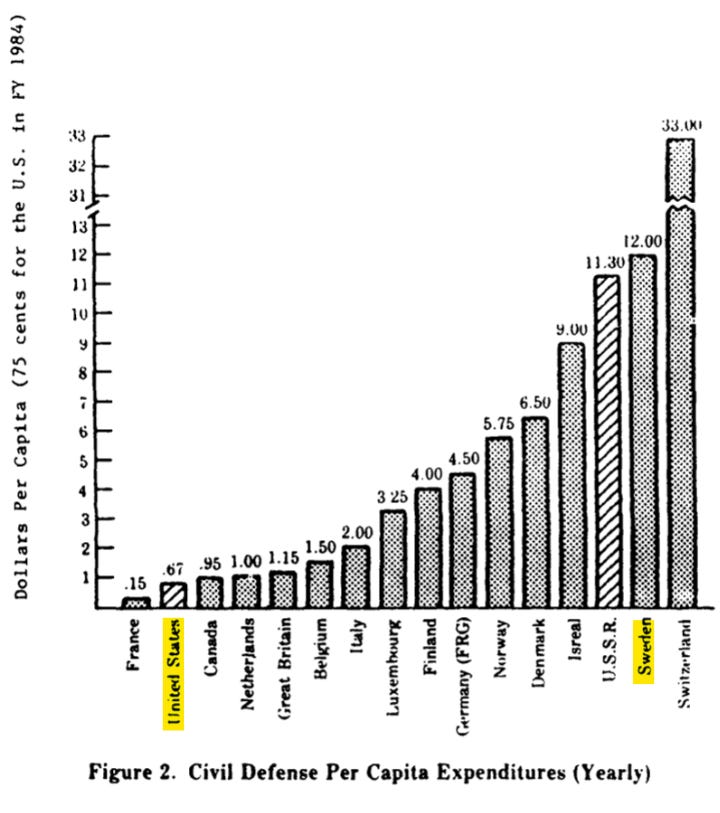
Going further, as Gary Kreps puts it in Social Structure and Disaster, “[Civil defense] and other war-related emergency management programs had static or declining budgets over most of the 30-year period before the establishment of FEMA.” Simply put, even during its heyday, civil defense in the US had more of a cultural grip on society than a functional and capacity-based one. Everyone remembers Burt the Turtle, recognizes the familiar fallout shelter signs, and can easily picture school kids practicing their duck and cover skills. What many don’t know is why there was a strategic shift during the 1970s from a focus on fallout shelters to mass evacuations. This was partly because there wasn’t sufficient funding for shelters. In fact, per capita wise, the US had some of the lowest civil defense expenditures in the world, and, besides the Cuban Missile Crisis, was rarely, if ever, fully funded. So, while there’s a certain level of cultural nostalgia for civil defense, and principles like individual preparedness are still very much valid, what works well for Sweden and others doesn’t mean that, if reimplemented, those strategies would work well elsewhere. All things considered, the All Hazards approach was adopted for a reason, and we can and probably should focus our efforts here on the system that’s been built on lessons learned from disaster after disaster over the past fifty years. So, instead of chasing the ghost of Adolphus and what’s in vogue across the Atlantic, we need to make the tough decisions, refine what’s proven effective, and reform and rid ourselves of what hasn’t.



First State Emergency Management
Wilmington, DE
Thanks for reading! Subscribe for free to receive new posts and support my work.